Reliably AI · LLM firewall

Introducing the LLM Firewall. Say Goodbye to Hallucinations.

Reliably AI grew out of a simple question: can we know when an AI system is about to hallucinate, before it ever opens its mouth?

That question became an open source library, hallbayes, a training‑free method for pre‑generation hallucination and drift detection. Within the first month it crossed 1k+ GitHub stars and 100+ forks, was adopted by multiple enterprise teams in production, and was selected by NVIDIA for integration into PyTorch Geometric and by Microsoft for Startups with six‑figure cloud support.
What we turn that into

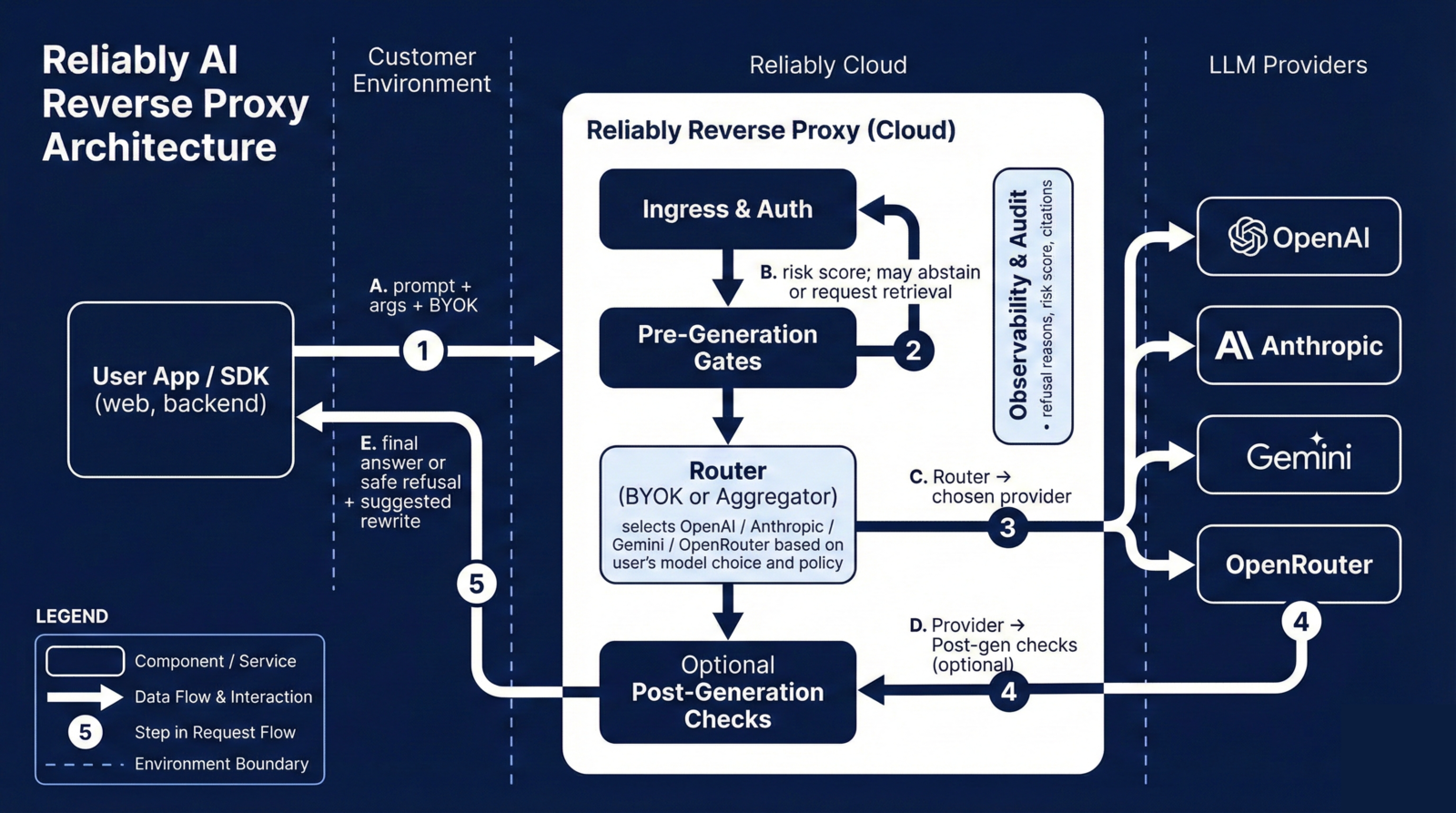
Reliably AI turns that research into a predictive trust layer for enterprise AI. We sit between your applications and the underlying LLMs to estimate hallucination and reasoning‑failure risk per request before generation — no model retraining, using only logprobs, even for closed frontier models. The platform combines pre‑generation risk scoring, automatic prompt rewriting, a hallucination guard that abstains when needed, and an interpretability dashboard. The same engine powers knowledge‑graph RAG decisions and is fully model‑agnostic.

Reliably AI product flowchart Click to zoom

Why this matters now

We’re building this because the reliability gap is now the bottleneck for GenAI: over 90% of enterprise pilots fail to show ROI, more than 40% of companies are abandoning projects, and even “hallucination free” tools are regularly caught hallucinating. That pain has created a clear wedge for us.

Our open‑source traction has already pulled in 15 named prospects at effectively zero CAC — including NVIDIA, Novartis, McKinsey and PwC — across platform partners, regulated enterprises and AI‑first startups, with an initial ARR opportunity sizing in the low single‑digit millions from just 8–12 customers.

Where we’re going

From here, our roadmap is about deepening that trust layer: SDKs for VPC and on‑prem deployments, richer interpretability and compliance reporting, and tighter integrations into the rest of the AI stack, so that any organisation can treat reliability as infrastructure.

If you are building AI systems where wrong answers are not acceptable, we’d like to talk.