Reliably AI · LLM firewall

Introducing the LLM Firewall. Say Goodbye to Hallucinations.

Reliably AI grew out of a simple question: can we know when an AI system is about to hallucinate, before it ever opens its mouth?

That question became an open source library, hallbayes, a training‑free method for pre‑generation hallucination and drift detection. Within the first month it crossed 1k+ GitHub stars and 100+ forks, was adopted by multiple enterprise teams in production, and was selected by NVIDIA for integration into PyTorch Geometric and by Microsoft for Startups with six‑figure cloud support.
What we turn that into

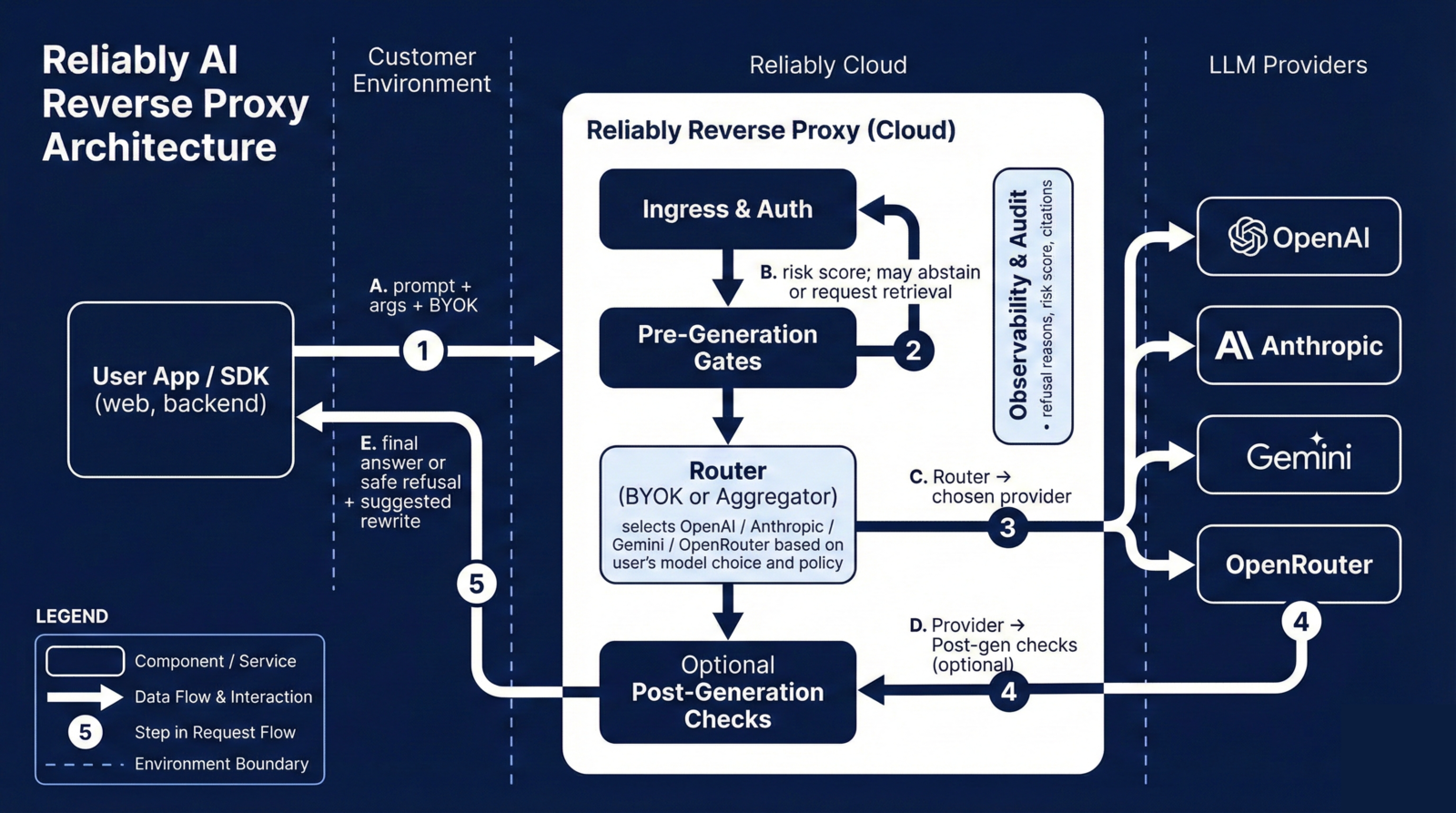
Reliably AI turns that research into a predictive trust layer for enterprise AI. We sit between your applications and the underlying LLMs to estimate hallucination and reasoning‑failure risk per request before generation — no model retraining, using only logprobs, even for closed frontier models. The platform combines pre‑generation risk scoring, automatic prompt rewriting, a hallucination guard that abstains when needed, and an interpretability dashboard. The same engine powers knowledge‑graph RAG decisions and is fully model‑agnostic.

Reliably AI product flowchart Click to zoom

MindGap

MindGap uses subnetwork activation patterns to automatically diagnose completeness gaps in enterprise knowledge graphs before they cause failures in production. Traditional knowledge graph validation requires expensive manual audits or oracle queries, leaving organizations vulnerable to failed queries, incorrect answers, and compliance issues.

We created an automated diagnostic map that enables enterprises to audit internal knowledge bases and RAG systems without manual review, while AI companies can validate training data completeness, identify holes in pre‑training datasets, and optimize fine‑tuning budgets by targeting only critical gaps. Grounded in Bayesian model averaging theory and validated on benchmark knowledge graphs, MindGap reduces risk by catching incomplete knowledge before deployment, transforming knowledge graph maintenance from reactive crisis management into proactive quality assurance.

Find out more

Synaptic

Synaptic eliminates compute waste in large language models by activating only the 10-20% of neurons needed for each specific task while maintaining frontier model performance. Current AI systems activate 100+ billion parameters for simple tasks like basic math, code completion, or translation, wasting compute resources and creating unnecessary cost barriers.

Our technology is grounded in the mathematical insight that language models already create probability distributions over activated subnetworks during inference, which we’ve engineered into task-adaptive sparse activation with safety thresholds to guarantee quality. This delivers 5-10x faster inference and 5-10x lower costs at the same quality level, enabling enterprises to deploy frontier intelligence on smaller infrastructure at a fraction of current costs while allowing inference providers to serve 5-10x more customers with existing hardware. Synaptic transforms expensive, resource-intensive AI operations into efficient, accessible deployments without sacrificing performance.

Find out more

Why this matters now

We’re building this because the reliability gap is now the bottleneck for GenAI: over 90% of enterprise pilots fail to show ROI, more than 40% of companies are abandoning projects, and even “hallucination free” tools are regularly caught hallucinating. That pain has created a clear wedge for us.

Our open‑source traction has already pulled in 15 named prospects at effectively zero CAC — including NVIDIA, Novartis, McKinsey and PwC — across platform partners, regulated enterprises and AI‑first startups, with an initial ARR opportunity sizing in the low single‑digit millions from just 8–12 customers.

Where we’re going

From here, our roadmap is about deepening that trust layer: SDKs for VPC and on‑prem deployments, richer interpretability and compliance reporting, and tighter integrations into the rest of the AI stack, so that any organisation can treat reliability as infrastructure.

If you are building AI systems where wrong answers are not acceptable, we’d like to talk.